In partnership with


Made In makes the cookware the world's best kitchens actually cook on. Our stainless, carbon steel, and forged knives are trusted in Michelin-starred restaurants and loved by millions of home cooks, built by master craftspeople using techniques honed over generations. No gimmicks. Just professional-grade tools that perform and last a lifetime.
Right now, that same cookware is at its lowest prices of the year. The End of Season Sale is live with up to 40% off, from the pans you reach for every night to full sets that outfit a kitchen in one move. It's the best time all season to trade up.
The cookware chefs choose, at the price home cooks have been waiting for.
Tip of the day
The transition zone gets easier the moment you stop treating it as one long walk to the kitchen. Split the six steps between the baseline and the kitchen line into three zones, and only two of them are places you want to hit from.
The first two steps in from the baseline are T1. Every ball above your belly button here is going out, so your paddle stays low and every ball you play is a short hop.
That makes your decisions in T1 simple. A good short hop earns you the trip all the way to the kitchen, an okay one moves you up to T2, a mediocre one keeps you in T1 waiting for a better ball, and a pop-up sends you back a step.
You can also just push balls back deep from T1 rather than trying to drop them. They land high and well behind the kitchen, but from that far back your opponent cannot do much with them.
The two middle steps are no man's land, and this is where resets go to die. From there your opponent can hit hard at your chest and hard at your feet, and you cannot tell whether the high ball is in or out.
T2, one to two steps behind the kitchen line, takes your feet away as a target. Anything aimed at your feet from that range has to be slow enough to be a dink, so speed-ups only come at or above your waist.
That lets you set your paddle high in T2 and choose between resetting and countering. Most of these balls come to the backhand, and a two handed backhand works well here because you can bump the ball back like a rebound net.
Getting there starts with the third shot, and the first fix is space. Crowding the baseline after your serve leaves you hitting off your back foot, so give yourself room and step in only when you read a slow return off the paddle.
Stay low through the third and do not pop up as you hit. Whether you are slicing, rolling, or driving, keep your weight forward without jumping through the shot.
The last fix is the length of your stroke. A long follow through with a slow swing holds the ball on the paddle longer and lets you aim, while a short slappy stroke is almost impossible to place.
Key points
In T1 every ball above your belly button is out, so keep the paddle low and short hop everything.
From no man's land your opponent can hit hard at your chest and hard at your feet.
A long follow through with a slow swing holds the ball on the paddle longer and lets you aim.
Deal of the day
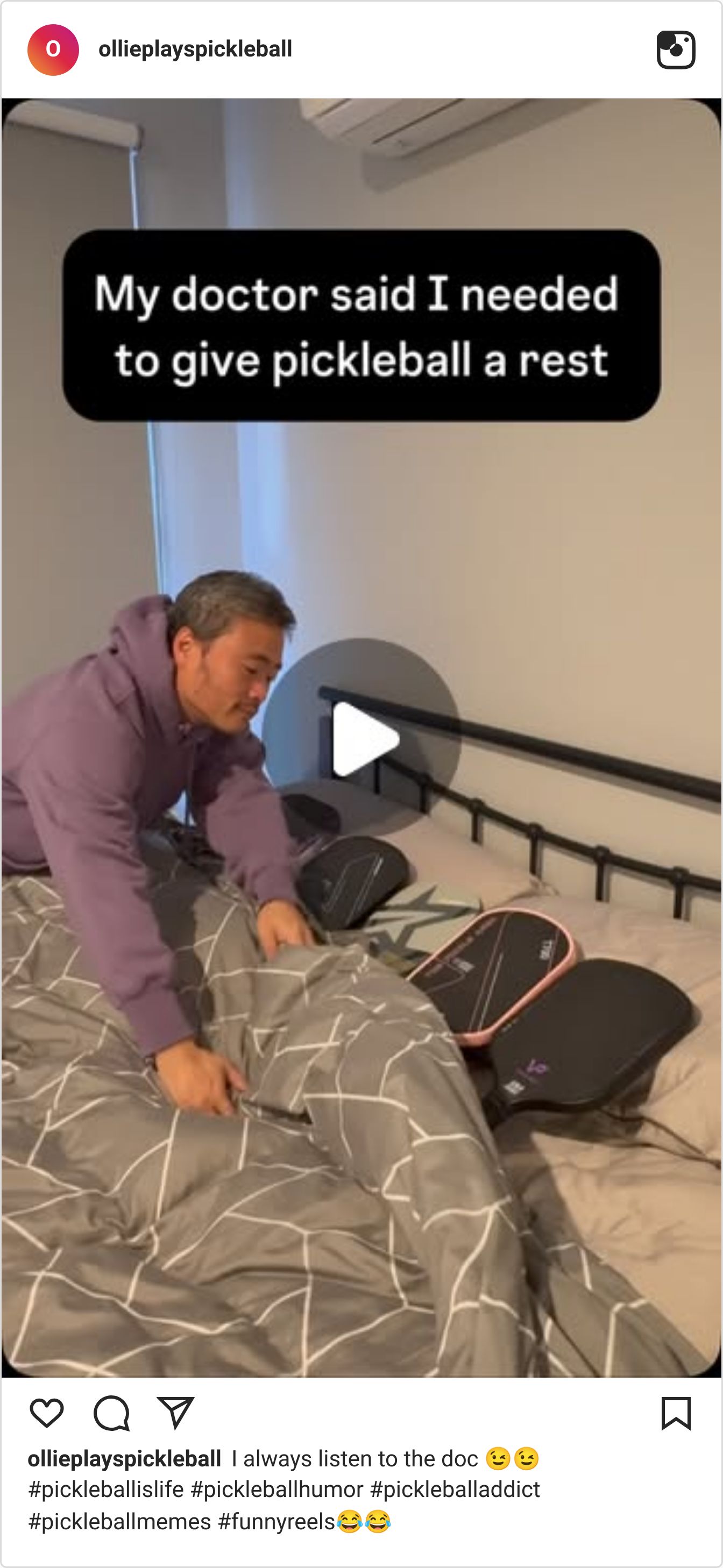
Meme of the day
Rest 🤣
That’s it for today! As always, thank you for reading. 🙏
What did you think of today’s newsletter? Please reply with how you think I can improve. I read your feedback and appreciate all of it (for real)! 😄
Happy pickling,
Paul
