
In partnership with

Pelosi Made 178% While Your 401(k) Crashed

Nancy Pelosi: Up 178% on TEM options
Marjorie Taylor Greene: Up 134% on PLTR
Cleo Fields: Up 138% on IREN
Meanwhile, retail investors got crushed on CNBC's "expert" picks.
The uncomfortable truth: Politicians don't just make laws. They make fortunes.
AltIndex reports every single Congress filing without fail and updates their data constantly.
Then their AI factors those Congress trades into the AI stock ratings on the AltIndex app.
We’ve partnered with AltIndex to get our readers free access to their app for a limited time.
Congress filed 7,810 new stock buys this year as of July.
Don’t miss out on direct access to their playbooks!
Past performance does not guarantee future results. Investing involves risk including possible loss of principal.
Tip of the day
This video provides seven advanced Pickleball IQ tips designed to instantly elevate your court strategy and help you outsmart every opponent you face.
The first tip addresses the net cord: never speed up a dink that nicks the net, as it loses all momentum, making an aggressive dink the better option to take control of the rally.
A key professional secret is the "hold" on a dead ball, which means pausing your paddle underneath the ball for a second to create deception and observe your opponent's reaction before you attack or lob.
You must be able to decipher when to use a third shot drive (short/high return or deep/aggressive return) versus a third shot drop (shallow/low return or deep/soft return).
To counteract match nerves, apply pressure on your opponents by hitting 70% power third shot drives instead of drops, or set a minimum dink rule with your partner before attempting any speed-ups.
Pros use patterns like running around to find their forehand, which they set up by dinking two balls wide before hitting the third to the opponent's inside foot for an attackable neutral return.
Apply maximum pressure on the fourth shot, which is your chance to attack the opponent's third shot drop either out of the air or by stepping back and driving it deep to force a difficult reset.
Finally, analyze your opponent's style, such as a two-handed dinker (who is not a kitchen flick threat) or an aggressive leaner (who is vulnerable to lobs and body bags), and reverse engineer their style to exploit their weakness.
Key Points:
Never attempt to speed up a dink that nicks the net; instead, hit an aggressive dink.
Use the "hold" on a dead ball to observe your opponent and add deception before attacking or lobbing.
Drive short/high or deep/aggressive returns, and drop shallow/low or deep/soft returns.
Counter nerves by hitting controlled third shot drives or setting a minimum dink count before attacking.
Condition your opponent with wide dinks, then hit to their inside foot to set up a run-around forehand attack.
Attack the opponent's third shot drop out of the air or with a deep drive to force a difficult fourth shot reset.
Dissect your opponent's play style to formulate a plan that targets their specific tendencies and weaknesses.
Consider this our entire pitch:

Morning Brew isn’t your typical business newsletter — mostly because we actually want you to enjoy reading it.
Each morning, we break down the biggest stories in business, tech, and finance with wit, clarity, and just enough personality to make you forget you’re reading the news. Plus, our crosswords and quizzes are a dangerously fun bonus — a little brain boost to go with your morning coffee.
Join over 4 million readers who think staying informed doesn’t have to feel like work.
Deal of the day
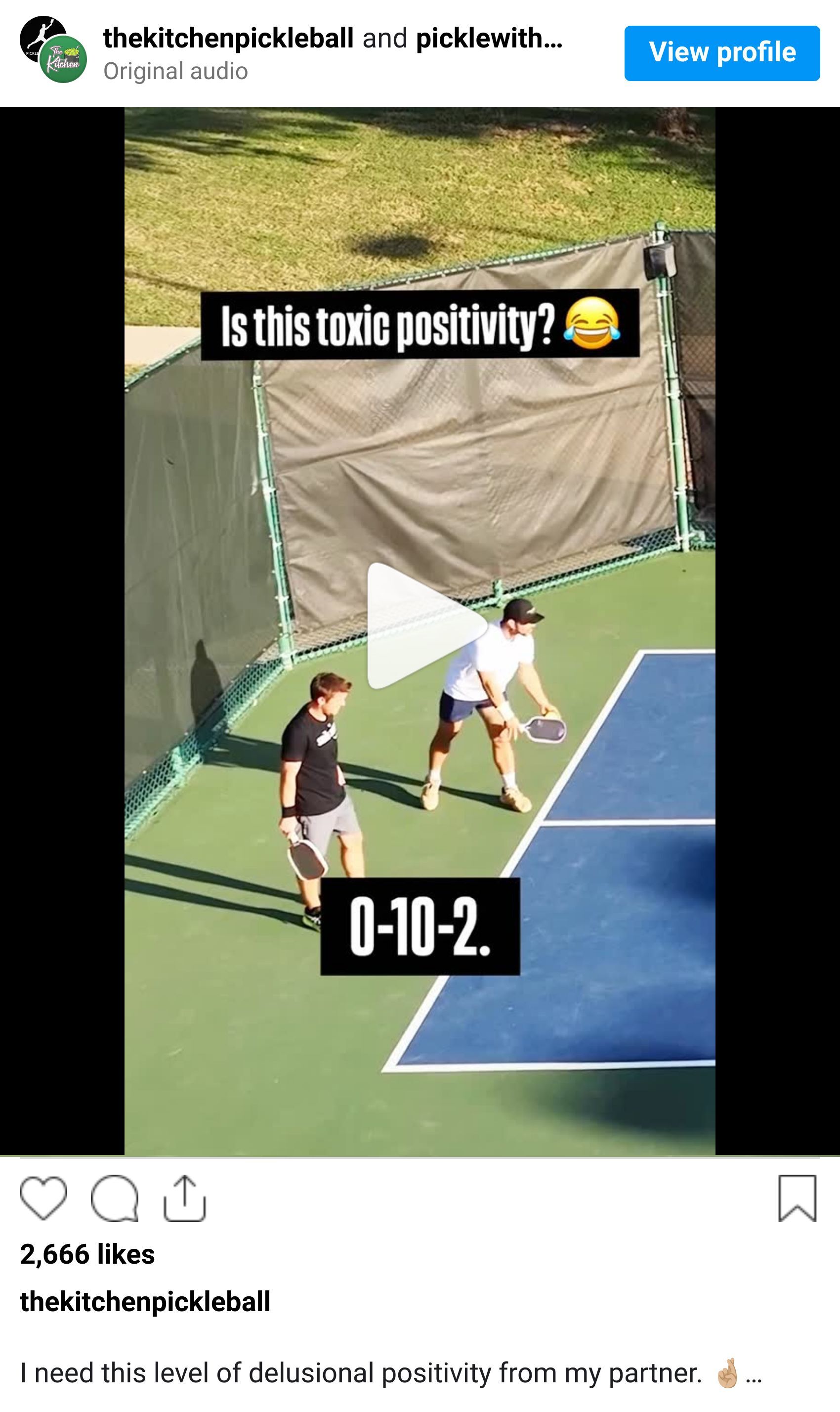
Meme of the day
Toxic positivity 🤣
That’s it for today! As always, thank you for reading. 🙏
What did you think of today’s newsletter? Please reply with how you think I can improve. I read your feedback and appreciate all of it (for real)! 😄
Happy pickling,
Paul
